

.svg)
.svg)
How to Build a B2B Sales Funnel: Stages, Metrics and Example 2026

Generate B2B Leads with AI?
With LeadScraper, you create suitable B2B lists in seconds. 100% GDPR compliant. No subscription required!
CREATE TEST ACCOUNTAlmost every sales team I talk to knows its close rate by heart. When I ask how many companies need to go into the top of the funnel to get there, the room goes quiet. Yet this one calculation decides whether a revenue target is achievable at all or whether the team spends a year chasing it. In this guide I walk you through the five stages of a B2B sales funnel, how to work it backwards from your revenue target and how to tell which stage is leaking. There is also a calculator, a fully worked example and the conversion rates I consider realistic for small and mid-sized B2B companies.
- A B2B sales funnel splits the path from first contact to signed deal into stages and measures, for each stage, what share of companies moves on to the next one. The pipeline is the stock of open deals, the funnel converts that stock into conversion rates.
- In B2B, groups of ten or more people make the decision. According to 6sense, buyers first contact a vendor only once 61% of the buying process is already behind them. The vendor contacted first wins 8 out of 10 deals.
- The top stage decides everything below it. If the wrong companies enter the funnel, every rate further down drops, however good your calls and proposals are.
- Work the funnel backwards from the revenue target. For €100,000 in quarterly revenue at a €15,000 deal value, typical rates mean you need around 850 well-matched target companies per quarter.
- An outbound funnel delivers predictable volume within weeks, an inbound funnel usually needs six to twelve months to get going. For most B2B companies the combination works best, with outbound as the first step.
What is a B2B sales funnel?
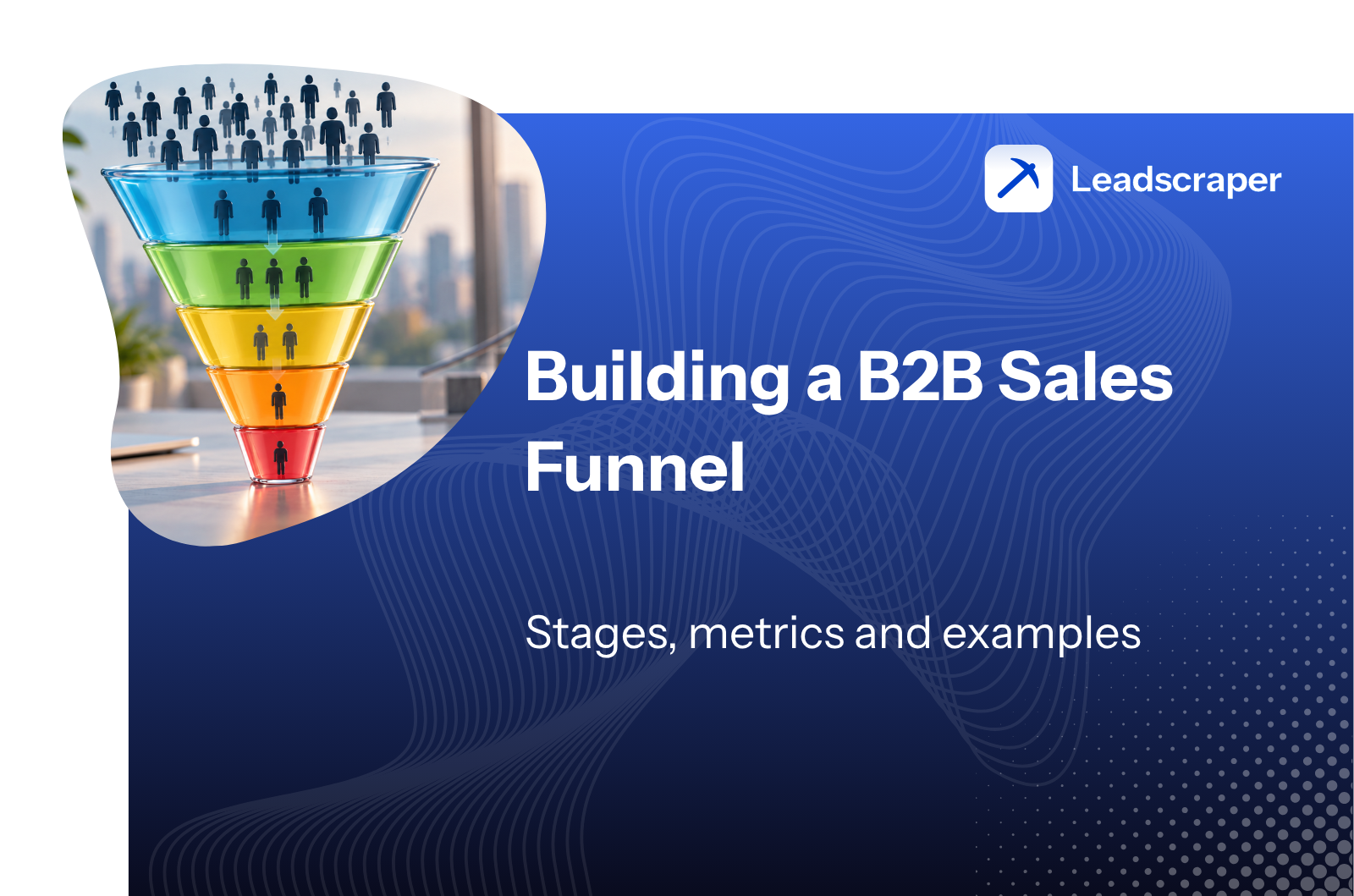
A B2B sales funnel is the model that divides the process of selling to business customers into consecutive stages and measures, for each stage, what share of contacts moves on to the next. At the top sit all the companies that fit your offer in principle. At the bottom sit the signed deals. Because contacts drop out at every transition, the model narrows towards the bottom. That is where the funnel image comes from.
Sales pipeline vs funnel is a distinction that gets blurred all the time, because the two are usually mentioned in the same breath. The pipeline is the concrete stock of open deals at each stage, with names and deal values. The funnel is the conversion of that stock into stage-to-stage rates. How to build the pipeline itself and run it day to day is covered in the guide to the sales pipeline. This guide is about the rates and what you derive from them.
The five sales funnel stages in B2B
I work with five stages because each of them has its own goal, a clear exit criterion and a measurable conversion rate. Some CRM templates use three, others twelve. Neither has helped me in practice. More stages create reporting effort without new insight, fewer stages hide the bottleneck. The rates in the overview are rules of thumb from outbound funnels at small and mid-sized B2B companies and do not come from any study.
Target audience and lead source
First contact
Qualification
Proposal and decision
Close and expansion
Stage 1: Target audience and lead source
Everything below depends on this stage. If companies enter the funnel that are too small, sit in the wrong region or simply do not have the problem, then meeting rate, proposal rate and close rate all drop at once. Sales then looks for the fault in how calls are run and proposals are written, when it actually lies in the list. Whenever I see a funnel for the first time, the list is the first thing I look at. In most cases that is where the bottleneck sits, long before a single call has been made.
An ideal customer profile needs hard criteria such as sector, headcount, region and legal structure plus at least one trigger that makes a need likely, for instance a new site opening, a job vacancy or a change of managing director. With Leadscraper you build this list from sector, region and company attributes. The system scores each company on how well it fits the profile. From your feedback it learns which matches you actually pursue. Two users with the same query end up with different lists over time, because the system understands their target audiences differently.
In a thread in the r/b2bmarketing subreddit, a consultant describes what he saw again and again across several B2B funnels he audited. The first point on his list concerns the top stage:
“Positioning was broad, so the wrong audience was entering. Demo forms were either too long or too vague. There was no clear qualification logic.”
A commenter adds how his team repaired their funnel by working backwards from the deals they had won:
“We rebuilt it by mapping the actual buyer journey backwards from closed deals. Turned out the prospects who watched our product demo video and visited pricing twice in 48 hours converted at 6x the rate of everyone else.”
Stage 2: First contact
First contact has two goals. First the contact has to respond at all, then that response has to turn into a booked discovery call. Getting a response in B2B takes several touchpoints over two to three weeks, usually a mix of email, phone and LinkedIn. A single call or a single email simply does not reach most contacts. How to build such a sequence and which channels work in the UK is covered in the guide to outbound lead generation.
Proactive first contact pays off for a reason that is often overlooked. According to the 6sense Buyer Experience Report 2025, buyers only get in touch with a vendor once 61% of their buying process (the buyer journey) is behind them. In 8 out of 10 cases they then go on to buy from the vendor they contacted first. Whoever is in contact early has a good chance of being that first vendor. Whoever waits for the enquiry usually has to displace a favourite later on.
Stage 3: Qualification
In the discovery call you clarify four points. What exactly is the problem? Why is it an issue right now? Who decides and within what budget? By when does a solution need to be in place? If any of these is missing, the deal does not belong in the proposal stage yet. Which questions have proven themselves and when a lead is truly qualified is covered in the guide to lead qualification.
The decision-maker point matters most. Ebsta and Pavilion analysed around 655,000 sales opportunities for their GTM Benchmarks 2025. Deals in which the decision-maker was involved early were won 55% more often. A proposal that only sits with the department that requested it therefore often stalls for weeks in the decision stage.
Stage 4: Proposal and decision
The proposal is read by people who have never spoken to you. In B2B, a buying group made up of the requesting department, procurement and senior management makes the decision, according to 6sense that is often more than ten people. So the proposal has to work without any prior knowledge. The first page states the customer's problem in their own words, the solution in two sentences, the numbers and the next step. Everything else belongs in the appendix.
The work only starts once the proposal has been sent. A proposal without follow-up rarely gets a reply, because in a buying group there is always someone who has not read it yet. A fixed cadence with a call after three days and another touch after a week is mandatory, more on that in the guide to sales follow-up.
Stage 5: Close and expansion
The signed deal is the end of the funnel and the start of the next one. According to the Pavilion benchmarks, 52% of new revenue now comes from expanding existing customers. Good onboarding, a fixed date for the next needs review and the request for a reference therefore belong in the funnel as a stage of their own.
Working the funnel backwards: how many companies need to go in at the top
The most important calculation in the funnel runs from the bottom up. You start at the revenue target, divide by the average deal value and work up through the conversion rates to find how many companies need to enter at the top. The result is often sobering, but it is the only number you can plan with.
Funnel calculator: from revenue target to target company list
Move the sliders to your own figures. Each rate refers to the transition into the next stage.
For €100,000 in quarterly revenue you need to win 7 deals, which takes around 858 well-matched target companies contacted in this quarter.
With the default values the calculator arrives at around 850 target companies per quarter. In my experience this is exactly the number at which many teams realise that their revenue target and their lead list do not match. A list of 200 companies that gets called three times a year will not carry a target of €400,000. Then there is capacity. One person running a five-touch sequence typically manages 60 to 80 new companies a week. For 850 companies a quarter that is a full-time role.
The calculation also shows which rate is worth working on. If the meeting rate rises from 20 to 25%, the number of target companies needed falls from 858 to 686. A close rate of 38 instead of 30% would have the same effect. On paper every rate has similar leverage, the difference lies in the effort. Five points of meeting rate is a better hook in your outreach, eight points of close rate is months of work on proposals and negotiations.
Inbound funnel or outbound funnel?
For most B2B companies an outbound funnel is the faster route to predictable volume, an inbound funnel the long-term complement. Both fill the top stage in different ways, each with its own conversion logic.
| Criterion | Inbound funnel | Outbound funnel |
|---|---|---|
| Ramp-up time | Usually 6 to 12 months before content and visibility bring in enquiries regularly | First calls after 2 to 4 weeks |
| Who enters at the top | Whoever happens to be searching, including students, competitors and companies that are too small | Only companies you selected beforehand against your ideal customer profile |
| Control over volume | Low, enquiries come when they come | High, more volume simply means more companies on the list |
| Upfront cost | High, content, website and ads run for a long time without any return | Manageable, a lead list plus the working hours for outreach |
| Typical response | Enquiries are warm but often still early in the buying process | Responses are cooler, but the contact sits directly with the decision-maker |
| Suits | Well-known brands, self-serve software, broad target audiences | Offers that need explaining, clearly defined target audiences, consulting and services |
The decision hinges on the buyer's pyramid that Chet Holmes described in his book “The Ultimate Sales Machine”. Only around 3% of any market is actively looking for a solution right now. A further 7% are open to one, 30% are not thinking about it at the moment but do have a need. The remaining 60% believe or know that they will not buy for now. Inbound reaches the 3% who are already searching and usually looking at several vendors at once. Outbound reaches the 7% and the 30% before they end up with a competitor. Anyone running only an inbound funnel is therefore competing for the smallest part of the market.
My recommendation for B2B companies with an offer that needs explaining is therefore clear. Start with an outbound funnel, because it delivers first calls and first rates within a few weeks. Build inbound alongside it once the outbound funnel is running. If you want to hand off the outbound part entirely, there is Leadscraper Autopilot for that. It takes over lead research, identifying the right contact and first outreach, so that only the calls and the close remain with you.
Building a B2B sales funnel in six steps
A funnel is created on paper, the CRM comes last. The six steps take about two working days in total, after that the funnel runs and gets adjusted weekly.
Step 1: Write your ideal customer profile on one page
Set four hard criteria a company has to meet, plus two triggers that make a need likely. An IT services provider, for example, writes “Manufacturing, 50 to 250 employees, the Midlands, owner-managed” with “job advert for an IT administrator” or “second site opened” as triggers. In my experience one page is enough. That page matters more than any script. How to derive the criteria is shown in the guide to the target audience for B2B leads.
Step 2: Define one main source for the list
The funnel needs a source that reliably delivers companies matching your profile. For outbound that is a lead list you pull by sector, region and attributes, one that also includes the right contact. Leadscraper works on a credit basis, so you pay for the companies you actually need. Inbound channels such as your website, trade articles and referrals run in parallel, but they remain the complement. Anyone who launches the funnel with three sources at once will not know after three months which of them worked.
Step 3: Define the outreach sequence
Define the channels, order and timeframe of your outreach. A sequence of just under three weeks with five touchpoints has proven itself. For example an email on day 1, a call on day 3, a LinkedIn connection on day 7, a second email referencing the trigger on day 12 and a final call on day 18. Every company goes through the same sequence, otherwise the rates are not comparable. Which channels are permitted for B2B outreach without prior consent is covered in the guide to cold calling.
This stage eats the most time. According to the Salesforce State of Sales Report 2026, sales reps spend 60% of their time on tasks that have nothing to do with selling. I consider this stage the best candidate for outsourcing, because it can be standardised cleanly and sales makes better use of its time in the calls. Leadscraper Autopilot takes over this part, from research through to first outreach.
Step 4: Define qualification questions and handover
Write the four qualification questions from stage 3 into the CRM as mandatory fields. A deal only moves into the proposal stage once all four are filled in. If marketing and sales work separately, it also has to be set down in writing from which point a lead goes to sales and how quickly sales responds. Otherwise you get the situation that almost every company with its own marketing team knows all too well.
A marketing lead asks in r/b2bmarketing why sales simply leaves some of the marketing qualified leads (MQLs) untouched, meaning the contacts that marketing has scored as ready. One reply names the cause:
“Let sales define what qualified means and score against that, they're ignoring your MQLs because the score doesn't predict anything they get paid on.”
Another commenter describes what actually worked in his team. Sales has sat in on the scoring review ever since. Every handover carries one sentence on timing:
“We also built a quick 'why now' note into the handoff, one sentence on what changed for the account recently. That cut the 'this is noise' complaints way down.”
Step 5: Set up CRM stages with exit criteria
Create the five stages in your CRM and write the exit criterion into the name or description of each stage. “Proposal” then becomes “Proposal sent and follow-up date set”. Without these criteria every rep moves deals on gut feeling. The rates then tell you nothing.
Add a “Revisit” stage with a date and a trigger for companies you reached that have no need right now. These are the 7% and the 30% from the buyer's pyramid. Without this stage they vanish from the funnel, even though they will buy next year.
Chris Walker, founder of Refine Labs, goes one step further in an episode of his podcast. He only counts a deal towards the forecast pipeline once it sits in a stage from which the team wins at least 25% of deals. For some teams that is the third stage, for others the fourth. The sole criterion is the win rate. I consider this the best definition of a forecast pipeline, because it ties forecast and funnel to the same number.
Step 6: Introduce a weekly funnel review
A funnel review takes 30 minutes and answers three questions. Which conversion rate has dropped compared with the last four weeks? Which deals have been sitting in a stage longer than the average cycle? How many new companies have entered the top of the funnel? The third question is the one most often forgotten and the most important, because an empty funnel entrance only becomes visible two months later as an empty proposal stage. Rates are only reliable from around 30 cases per stage, before that you are better off counting absolute numbers.
Example: the sales funnel of an IT services provider
An IT services provider in the Midlands sells managed services to manufacturers with 50 to 250 employees. A contract brings in €18,000 on average in the first year. The target is four new customers per quarter. Each quarter sales pulls a list of 400 companies against the ideal customer profile and runs the outreach sequence from step 3.
| Stage | Companies | Rate to next stage |
|---|---|---|
| 1. Target companies on the list | 400 | 35% reached |
| 2. First contact with response | 140 | 25% meeting rate |
| 3. Discovery call | 35 | 40% proposal rate |
| 4. Proposal | 14 | 29% close rate |
| 5. Deal won | 4 | €72,000 in new revenue for the quarter |
Four deals from 400 companies is an overall rate of one percent. That sounds low, but for an outbound funnel selling a service that needs explaining it is a solid figure. The example gets interesting when the provider wants five deals in the next quarter.
Route one goes via the close rate. If it rises from 29 to 35%, 14 proposals turn into 5 deals. Route two goes via the reach rate. If it rises from 35 to 45%, say through an additional channel in the sequence, 180 companies are reached, 45 calls held, 18 proposals written and likewise 5 deals won. Both routes deliver the fifth deal. The second one also produces ten more calls and four more proposals, so more pipeline and more feedback on what works in the sequence. In this case I would always work on the reach rate first. A close rate takes months to lift, through decision-makers in the proposal, follow-up cadence and proposal structure. An additional channel goes into the sequence within a week.
Metrics that steer the funnel
Five numbers are enough to run a B2B sales funnel. Everything beyond that is reporting for senior management and does not help in the weekly rhythm. If I were allowed to see only one of them each week, it would be the first.
- New target companies per week: the number of companies entering the top of the funnel and going into the sequence. It is the earliest warning of any later bottleneck.
- Conversion rate per stage: the share of companies moving from one stage to the next. This is the core number of the funnel and shows the bottleneck.
- Response time: the time between an enquiry or reply from the customer and your response, measured in hours.
- Cycle length per stage: the average time a deal spends in each stage. Deals that sit there noticeably longer are usually already lost.
- Average deal value: together with the revenue target, this determines how many deals and therefore how many target companies are needed.
Response time is the most underestimated of these. A study in the Harvard Business Review measured how quickly 2,241 US companies responded to enquiries through their websites. On average 42 hours passed, only 37% replied within an hour. The same authors also analysed 1.25 million leads. Companies that responded within an hour qualified the lead almost seven times as often as companies that were just one hour later. Compared with companies that waited 24 hours or longer, the factor was over sixty. The same principle applies to the outbound funnel. Anyone who responds to a contact's reply two days later has missed the moment when the topic was at the top of that person's desk.
In r/SaaS, a vendor who examined his customers' B2B funnels reports that most enquiries sit in a queue for four to six hours before anyone responds:
“Companies that respond to inbound leads within 5 minutes convert at 3-4x the rate of companies that respond within an hour. Not because the pitch is better, just because they showed up first.”
The following benchmarks help you place your own rates. They apply to outbound funnels at small and mid-sized B2B companies with a well-maintained target list and a sequence across several channels. Which metrics to set up in the CRM for this and how to monitor them day to day is covered in the guide to sales pipeline metrics.
| Transition | Typical range | If you are below it, check first |
|---|---|---|
| Target company to first contact with response | 25 to 45% | Data quality of the list, right contact person, number of channels in the sequence |
| First contact to discovery call | 15 to 30% | Reference to the trigger in your outreach, ideal customer profile too broad |
| Discovery call to proposal | 30 to 50% | Qualification questions, calls with people who have no decision-making authority |
| Proposal to deal | 20 to 35% | Decision-maker involved in the proposal, follow-up cadence, proposals sent to unqualified deals |
Common mistakes in the B2B sales funnel
Most funnels fail on the same six execution mistakes. The first is the one I see most often.
The wrong companies at the top
A bought list without an ideal customer profile, or a list that has not been cleaned in years. The sequence then runs against companies that will never buy. No optimisation further down makes up for that.
Too many stages
Twelve stages in the CRM that nobody maintains properly. Five stages with clear criteria deliver more insight than twelve filled in on gut feeling.
Stages without exit criteria
If “Proposal” means something different to every rep, the proposal rate tells you nothing. Every stage needs a condition that has to be met.
Responding to replies too late
Enquiries that sit for two days. Replies to a response that only go out after the weekend. Response time is the cheapest lever in the entire funnel.
“Qualified” means two different things
Marketing means a white paper download, sales means a call with a confirmed need. As long as that is not settled in writing, leads get left behind.
Funnel built and never touched again
Rates shift with the market, the season and the offer. A sequence that had a 35% reach rate in spring sits at half that in August. Without a review you only notice once the proposal stage is empty.
The fifth mistake has even been given a name of its own at Gartner. In a talk for the Gartner Sales Practice, Brent Adamson describes the path from marketing qualified lead via sales accepted lead to what he calls “NMP”, “not my problem”. Once marketing has handed over the lead, nobody feels responsible any more. His conclusion matches the Reddit discussion above. From the buyer's point of view there is no handover between marketing and sales. So the funnel must not contain a handover at which responsibility ends. Whoever accepts the lead stays responsible until the customer replies.
Conclusion
A B2B sales funnel stands or falls with its top stage. With the right companies and the right contact in the funnel, the rates below are half won. With the wrong ones you end up optimising calls and proposals for companies that will never buy.
My advice is therefore to start with the backwards calculation from the revenue target and build a list from it that matches your ideal customer profile. Leadscraper delivers that list and learns with every piece of feedback which companies fit you. You can also hand first contact over to Autopilot and concentrate on qualification and closing.
A small plan is enough for this week. Use the calculator above to work out your target companies per quarter, write the ideal customer profile on one page, set up the five stages with exit criteria in the CRM and start the first sequence. After four weeks you will have your first calls and the first two rates, after a quarter reliable numbers across all stages.
Frequently asked questions about the B2B sales funnel
How many stages should a B2B sales funnel have?
Five stages are enough in most cases. Target audience and lead source, first contact, qualification, proposal and decision, plus close and expansion cover the path from first contact to follow-on business. More important than the number of sales funnel stages is that each stage has a clear exit criterion and the rate for each transition is measured.
Sales pipeline vs funnel: what is the difference?
The pipeline is the concrete stock of open deals per stage, with company name and deal value. The funnel converts that stock into stage-to-stage rates and shows where deals are lost. Both use the same stages but answer different questions.
What conversion rate is normal in a B2B sales funnel?
From target company to signed deal, the overall rate in outbound funnels usually sits between 0.3 and 2.5%. Per stage, a 25 to 45% reach rate, a 15 to 30% meeting rate, a 30 to 50% proposal rate and a 20 to 35% close rate are typical figures for small and mid-sized B2B companies.
How long does it take to build a B2B sales funnel?
Planning the ideal customer profile, sequence, qualification questions and CRM stages takes about two working days. An outbound funnel delivers first calls after two to four weeks and reliable rates after a quarter. An inbound funnel usually needs six to twelve months before it brings in enquiries regularly.
Do I need a CRM for the sales funnel?
For the first few weeks a spreadsheet with one row per company and one column per stage is enough. As soon as more than one person works on the funnel or more than 100 companies are open at the same time, you need a CRM, because otherwise response times and exit criteria can no longer be tracked.
Should I run new and existing customers in separate funnels?
Yes. Existing customers skip the target audience and first contact stages and have markedly higher proposal and close rates. In a shared funnel they distort the rates of new business. The bottleneck in the top stage then stays invisible.
%2520(7).jpeg)